
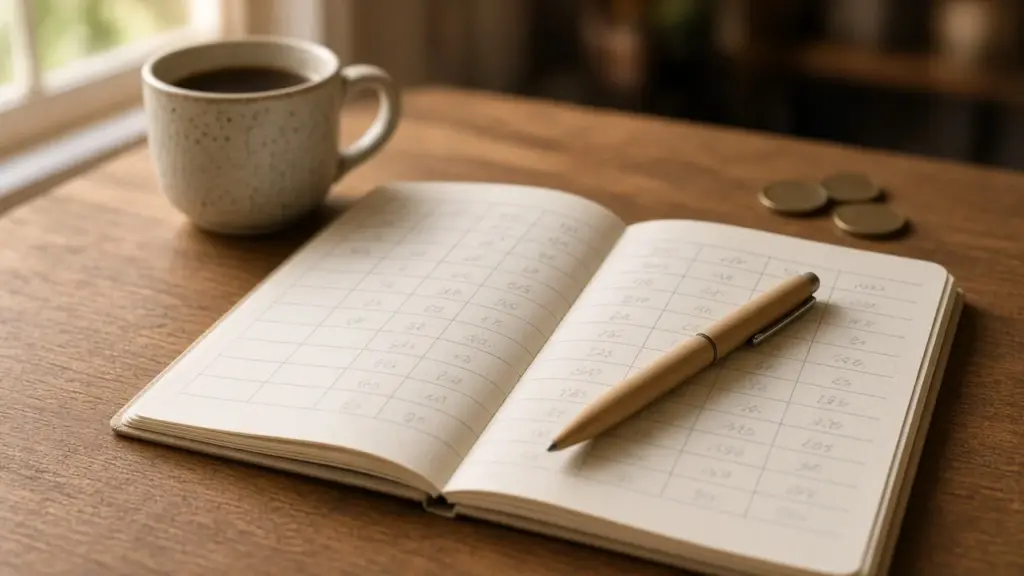
Two memos, written at different times, that clearly belong together.
“If you want to know accounting, the start is a 가계부.” (A household ledger. Also called a 금전출납부, a cash book.)
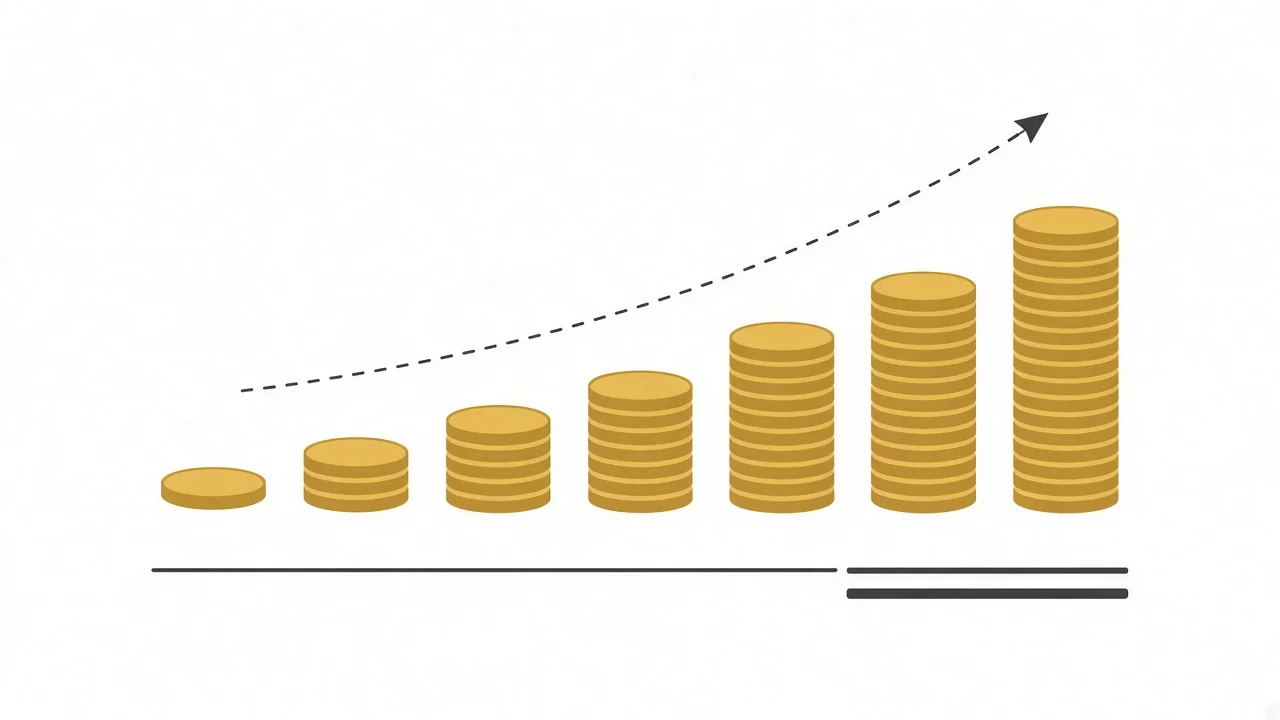
And: “It’s all built from 100 won and 100 won piling up.”
One is about a notebook. The other is about coins. Both are about the same thing.
What a 가계부 is
If you grew up in Korea, you probably know the 가계부. It’s a household account book. Money in on one side, money out on the other. Date, item, amount.
It’s not fancy. That’s the point. You don’t need a finance degree. You need a pen and the patience to write down “milk” again.
I grew up watching my mother keep one. I’ve tried keeping one myself, too. I just couldn’t keep it up. Writing down “milk” is easy once. It’s the four hundredth time that gets you.
A documented example from Japan
I wanted to know where this habit came from. For Korea, I couldn’t find a history I’d trust enough to repeat here. So I’ll leave that part blank rather than guess.
Japan, though, has a clear record. There the household ledger is called kakeibo, and one version has a famous origin.
According to its publisher, Fujin no Tomo Sha, Hani Motoko published her 『家計簿』 (household account book) at the end of 1904. The publisher says that, among household account books still published every year, it’s the one that has been used the longest in Japan. The only gap was four years during and after World War II, when paper controls stopped it.
So the plain paper ledger has been going strong for over a century. Smartphones have been around for about a sixth of that.
Why “accounting starts here”
My first memo says accounting starts with a 가계부. I think that’s true, in a simple way.
Big accounting has big words. Assets, liabilities, cash flow. But underneath, it’s the same question a 가계부 asks:
What came in? What went out? What’s left?
If you can answer that for one household, you understand the basic idea. The rest is more rows.
The 100 won memo
Now the coin memo.
A 100 won coin is a small thing. You don’t think about it. It sits at the bottom of a bag. It falls behind the couch.
But “100 won and 100 won” is how almost everything gets built. Savings. Debt, too. Nothing shows up all at once. It piles.
A 가계부 is the tool that makes the pile visible. Without it, small amounts are invisible. You notice them only when they’re big.
Writing down small things feels silly. You write “coffee.” You write “bus.” It feels like keeping a diary for your wallet.
But that’s exactly where the information is. The big purchases you remember anyway. The small ones are the ones that quietly add up.
Paper or app?
There are lots of budgeting apps now. Some connect to your bank and sort everything for you.
That’s convenient. But there’s something about writing by hand. You have to look at each line. You can’t skip the coffee.
I’ll be honest, though. These days I snap a photo of each receipt and keep track in an app. The pen lost to the phone camera.
How to keep a household ledger notebook (5 steps)
If you want to try it, the simplest version is very small.
- Get one notebook. Any notebook works. Nothing fancy.
- Draw five columns: date, item, category, amount, monthly total.
- Write one line per purchase. Even the small ones. Coffee. Bus. Milk. The small ones are the ones that quietly add up.
- Add it up at the end of the week. Don’t judge it. Just look.
- Keep a running total in the last column. The last line of the month is your monthly total.
Here’s what a page might look like (example numbers, not my real spending):
| Date | Item | Category | Amount | Monthly total |
|---|---|---|---|---|
| Oct 1 | Milk | Groceries | $4.00 | $4.00 |
| Oct 1 | Coffee | Eating out | $5.00 | $9.00 |
| Oct 2 | Bus | Transportation | $2.75 | $11.75 |
That’s it. That’s the whole system. You can make it more complicated later. Most people who quit, I’d guess, quit because they started complicated.
The last line on the page
At the bottom of a 가계부 page, there’s usually a total.
It’s just a number. A plain number, written in pen, made of a lot of small numbers above it.
Sources: Fujin no Tomo Sha, “婦人之友社の家計簿は創刊120周年を迎えます” (Fujin no Tomo Sha’s household account book marks its 120th anniversary).
Pingback: Heating Bill Shock, and the All-Electric House in My Head – Sky is Good (Mostly)
Pingback: The Most Powerful Way to Make Money (Is the Hardest One) – Sky is Good (Mostly)