
Here’s the memo. I didn’t soften it.
“What am I pursuing? Worrying, not deciding, not moving. That’s me.”
That’s a pretty honest thing to write to yourself. A little rude, too. I’d never say that about a friend.
But I wrote it. So let’s look at it.
Short answer: in the famous 2000 jam study, shoppers were far more likely to buy from a table of 6 jams than from a table of 24. But a 2010 meta-analysis of 50 experiments found the average choice-overload effect was virtually zero. More options don’t always make us freeze.
The donkey
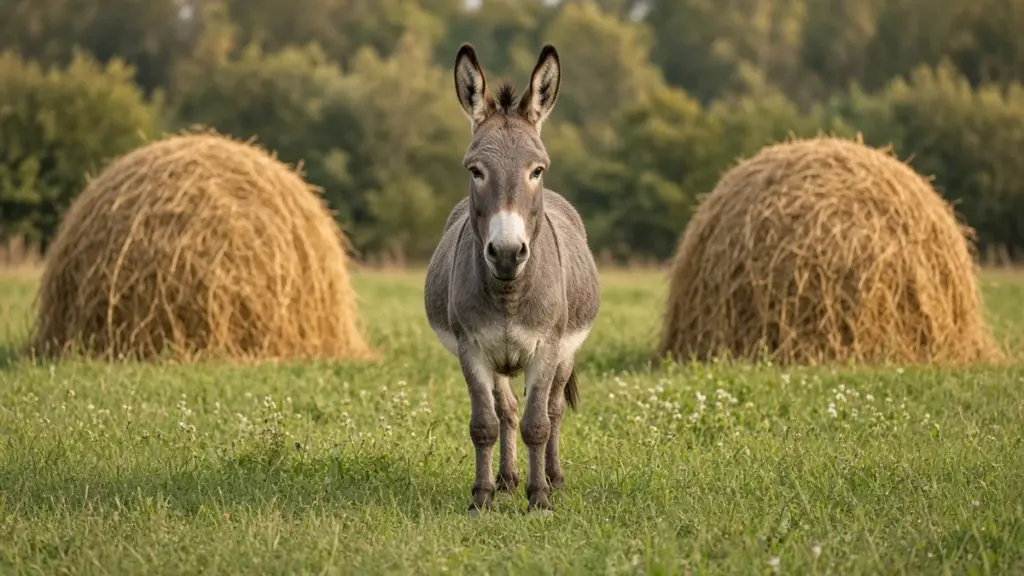
There’s an old thought experiment people call Buridan’s ass. A donkey stands exactly between two identical piles of hay. Equally hungry for both. No reason to pick one over the other.
So it doesn’t pick. And it starves.
It’s named after John Buridan, a 14th-century philosopher. Here’s a fun detail, though. The Stanford Encyclopedia of Philosophy notes that the donkey example is nowhere to be found in Buridan’s writings. Versions of it go back at least to Aristotle.
So the most famous example of indecision is attributed to a man who may never have written it. Very on brand for the topic.
The donkey is my spirit animal. Two good options, and I’m standing there, hungry, comparing hay.
Right now my hay is things like this. Should I do YouTube or not? Should I draw or not? Each one is a simple yes or no. And I’m still standing there.
The jam study
If you’ve read anything about decisions, you’ve probably heard of the jam study.
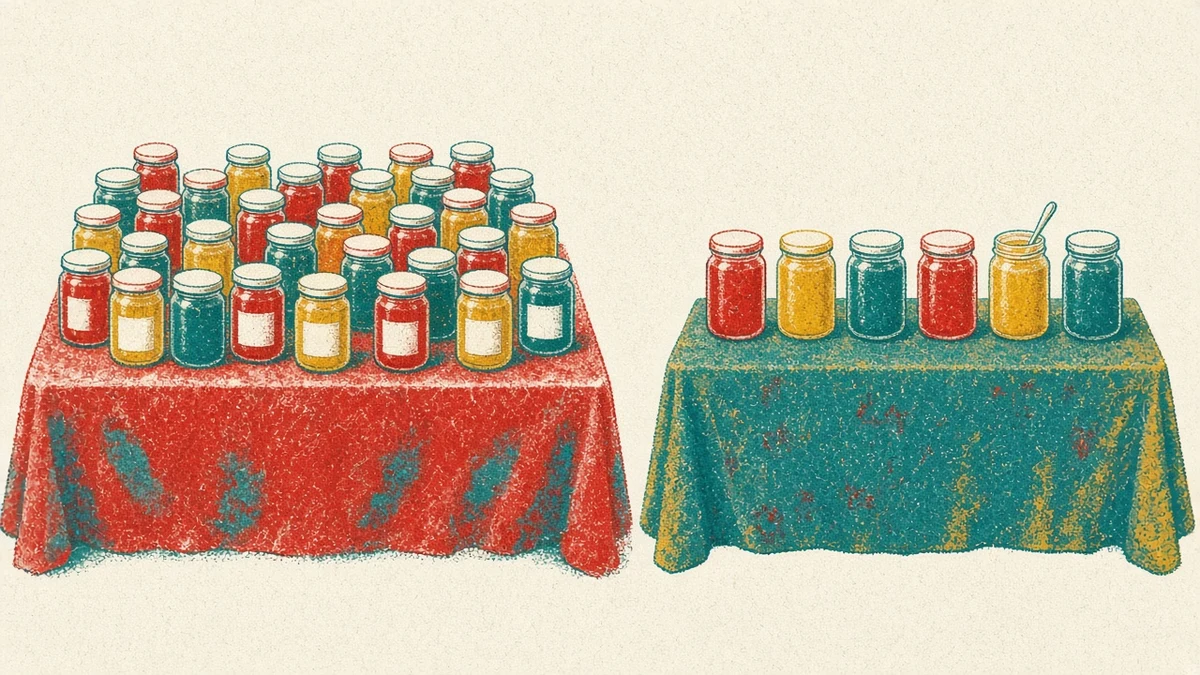
In a study published in 2000, psychologists Sheena Iyengar and Mark Lepper described a tasting booth at a grocery store. Sometimes it had 24 kinds of jam. Sometimes 6.
The big display drew more people in. About 60 percent of passing shoppers stopped, compared with 40 percent for the small one. But when it came to buying, nearly 30 percent of the people who stopped at the 6-jam table bought a jar. At the 24-jam table, it was only 3 percent.
The story people tell from this: too many choices make us freeze. It’s a great story. It’s in a lot of talks.
The part of the story that often gets skipped
Here’s the thing. Later research didn’t find the effect so cleanly.
In 2010, Benjamin Scheibehenne, Rainer Greifeneder and Peter Todd looked at 50 experiments on “choice overload” together. That kind of study is called a meta-analysis. Across all of them, the average effect was virtually zero.
Some studies found that more choices hurt. Others found the opposite. Others found nothing.
So “too many choices make people freeze” isn’t a law. It might happen sometimes, for some people, in some situations. The researchers were trying to figure out when.
I find that comforting, actually. It means indecision probably can’t be solved with simple math, where more options always equals more freezing. It’s messier and more personal than that.
Where my overthinking lives
Mostly, it lives in the gap between who I want to be and what I should do next. I want to be a lot of things. That means a lot of options, and every option is a real one. So I don’t pick. I keep comparing.
And it’s not only the big stuff. Hand me a restaurant menu and you’ll see the same donkey, just with better lighting.
The memo started with a bigger question. “What am I pursuing?” I think that’s the root. When the big direction is fuzzy, every small decision feels heavier. Each one feels like it might be the one that decides everything.
When I know what I’m going for, small choices get easier. Not easy. Easier.
Overthinking is a skill. Deciding is a different skill.
If my memo is right, I’ve had a lot of practice thinking. Seeing several sides of a question. Imagining how each choice goes wrong.
That’s useful sometimes. You don’t want to be the person who never thinks.
But deciding is its own thing. It’s a muscle that only grows by doing it. And I’m, let’s say, still at the beginner level. Amateur.
Small decisions, out loud
I’m not giving advice here. I’m not qualified, and the jam study already taught me how complicated this is.
I’ll just describe the donkey’s other option, which is never mentioned in the story.
One pile. Walk over. Eat.
The other pile will still be there tomorrow.
Sources: “John Buridan,” Stanford Encyclopedia of Philosophy; Iyengar & Lepper, “When Choice Is Demotivating: Can One Desire Too Much of a Good Thing?” Journal of Personality and Social Psychology (2000); Scheibehenne, Greifeneder & Todd, “Can There Ever Be Too Many Options? A Meta-Analytic Review of Choice Overload,” Journal of Consumer Research (2010).