
I wrote the original version of this as a two-part series in spring 2021. I merged them here because part two only makes sense after part one.

You can’t hit a target you can’t see.
That sounds obvious. And yet most people building a brand, whether it’s a company, a side hustle, a product, or just themselves, skip straight to making stuff. They never stop to picture who will watch their content or use their product. They just keep producing, get exhausted, and never figure out why.
So before we talk about logos or colors, two basics. How people buy. And how trends move. Almost nobody studies these two before branding. You’re reading this, so you already are.
How people buy: from AIDMA to AISAS
Every person on this planet is a consumer. And every consumer buys in a pattern.
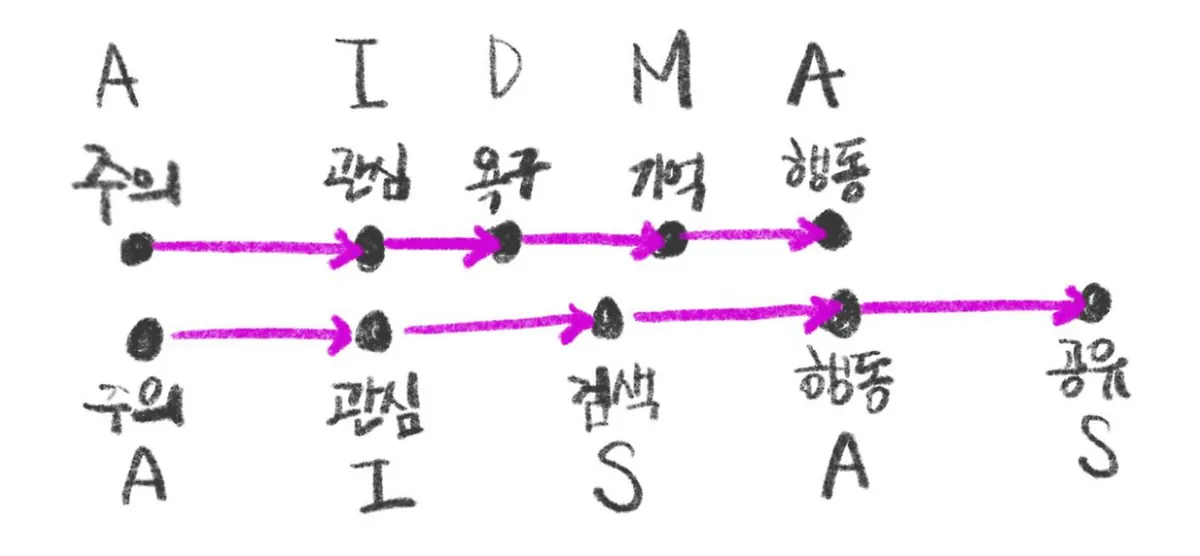
The old pattern was AIDMA:
- Attention: something catches your eye.
- Interest: you get curious.
- Desire: you want it.
- Memory: you remember it, think it over, compare.
- Action: you buy.
The current pattern is AISAS:
- Attention
- Interest, and at the same moment…
- Search: you look it up.
- Action: you buy.
- Share: you tell your followers and neighbors about it.
Smartphones and light, quick web services changed the pattern. People buy sooner. And after they buy, their own reviews and shares can decide whether a product lives or dies.
We’re living through a shift of power from the seller to the buyer. The simple version: we used to take what we were given. Now, more and more, we get what we ask for.
If you really understand that power and that pattern, and build your company, product, or content around it, people will gather around you. Sales will follow more easily, and more accurately.
How trends move: the 8 groups
Trends have an order, too. You can split the flow of a trend into eight groups of people, lined up by how fast they adopt something new.
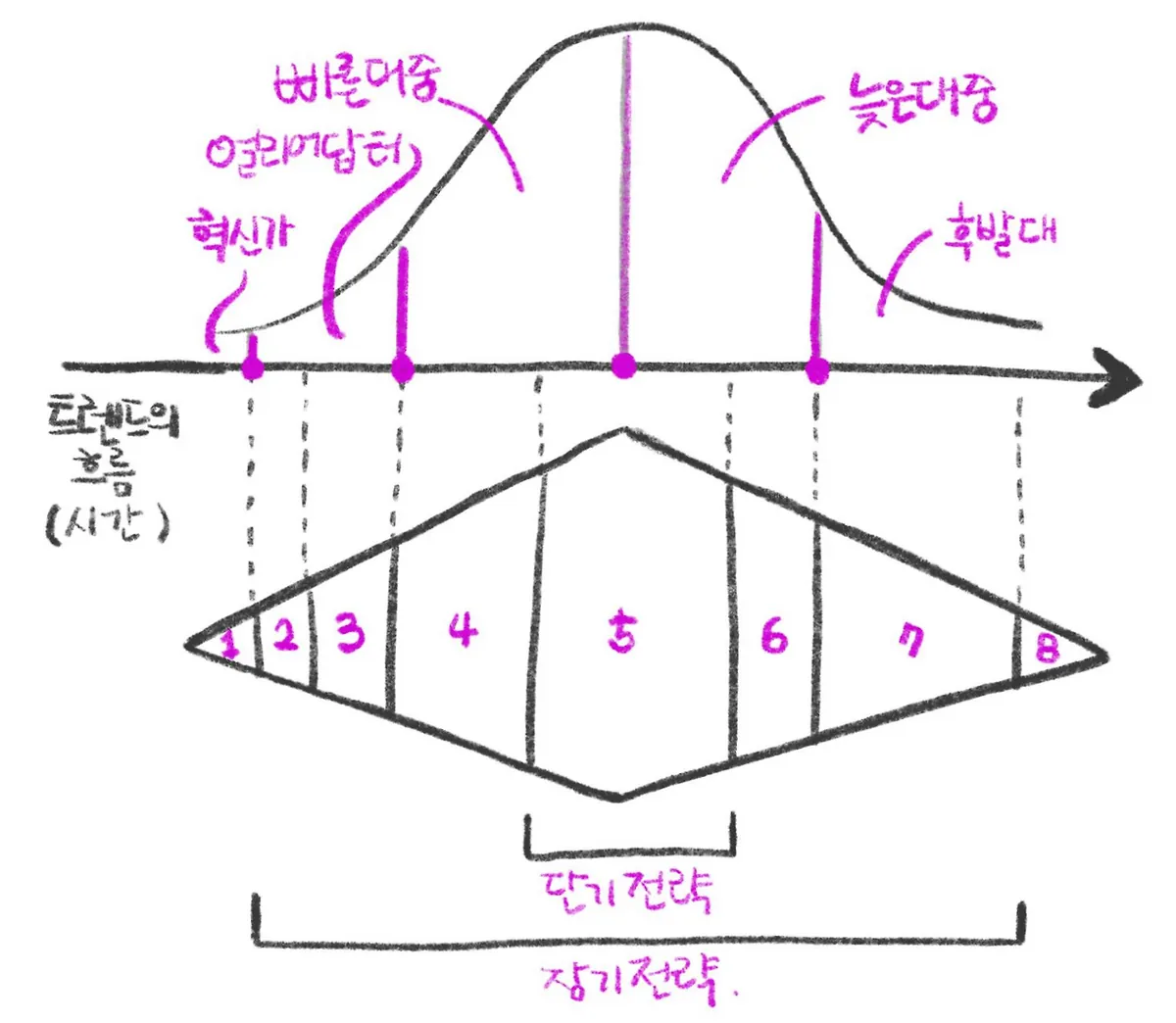
- Trend creators. They make new things happen, trend or no trend. Pure originators. Roughly 1% of people.
- Trend setters. Curious individualists, open to new styles. They don’t invent the trend, but they’re the first to adopt it and make it stick. The fast adopters.
- Trend followers. Open to change, much like the setters, but they want proof first. They follow styles the setters have already tested. The watchful adopters.
- Early mainstreamers. They like new things before they go big, but they’re more hesitant than followers. They only try something after they’ve seen someone around them do it.
- Mainstreamers. They adopt once most people have. They never grab something first, and they don’t cling to it at the end either. Very sensitive to the word “trend.”
- Late mainstreamers. They resist change. When they finally can’t find what they want anymore, they buy something new, usually a product that’s been out for years and is now completely ordinary.
- Conservators. They stick to styles from years, even decades, ago. Their taste is their taste. Their jeans may be older than you.
- Anti-innovators. The most skeptical of anything new. Not happening. Ever.
Why care? Because you need to know how many people sit in each group, which group leads, and which group your brand is really talking to.
Two ways to play it
Go for the middle (group 5). If your product needs to work fast and win people over without any friction, aim for the mainstream, where most people are. That’s the play I saw from companies like Coca-Cola, Starbucks, and Google. Familiar, comfortable, pitched at eye level, with design to match. They persuade you so naturally you barely notice.
Start with the setters (group 2). If you want a longer-lasting effect and you’re willing to take a risk to plant your flag hard, start with the trend setters and let it spread outward. Be special, but in a way everyone can eventually embrace. That’s how I saw Tesla, Apple, and Microsoft play it. They chase the future, and sometimes they boldly put out products that feel strange to us at first. Then users slowly grow, the product settles into everyday life, and by then it’s already the trend, steering what we buy.
Positioning: find the spot, then throw
Positioning means knowing what you’re aiming at, finding that exact spot, looking right at it, and throwing.
The catch is that the target isn’t something you can see. You plan, you design, you promote, you get seen, and finally somebody buys. In other words, the real target is moving the buyer’s heart.
Think about pointing at one spot with your finger. First you open your eyes and take in everything around you. Then you ignore most of it and lock onto one point. Seeing the whole scene comes first. Pointing comes second.
Same with a market. To pick your spot, you need to see the whole market first. It breaks down into four kinds of factors:
- Demographics (age, gender, family, education). Kids, high schoolers, college students, office workers, parents, seniors? Men or women? Small families or big ones? What kind of education do your people have?
- Geography (region, city, density, city size, climate). Mountains, the coast, a big city, a small town? Crowded places? How big is the city? What’s the weather like?
- Psychographics (personality, social class, motivation, lifestyle). What are your users like as people? I hate admitting classes exist, but how well-off they are is an important signal. What motivated them? What kind of life are they after?
- Behavior (attitude, tendencies, usage, usage rate, patterns, loyalty). How do they treat people and things? Do past users come back? Are most of them first-timers?
For each one: imagine, then choose.
STP: slice, aim, land
Once you can see the whole picture, chop it into small pieces. That’s Segmentation. Lay every piece out in front of you, sort clearly what applies and what doesn’t, and keep only what fits. Then sketch your whole brand from those pieces. Keep imagining and simulating: where does my brand shine brightest?
Next come targeting and positioning. They sound like the same thing. They’re not.
Targeting is something you do. Positioning is something that happens to you. Targeting is the throw. Positioning is the catch.
With targeting, you’re in charge. You imagine a specific type of person. For example (this one is completely made up for illustration): “A confident 25-year-old woman in New York, just back from studying abroad and starting her career. Honest, strong personality, gets a lot of attention. Runs a one-person business online, earns well, loves beauty products.” You can already picture her, right? That’s targeting.
With positioning, you’re not in charge. The people you targeted are. Their minds decide. Whatever method you use, the goal is always the same: earn a little corner of the buyer’s mind.
If you make content, you try to become your viewer’s friend, with good planning and real fun. If you make products, you push your user’s convenience and benefit as far as it goes, until they become fans.
So, one more time:
- Segmentation: slice the market.
- Targeting: choose who you’re aiming at.
- Positioning: earn your spot in their mind.
Whether your brand is a company, a product, or just you, I hope you aim carefully and find a position that’s yours.