
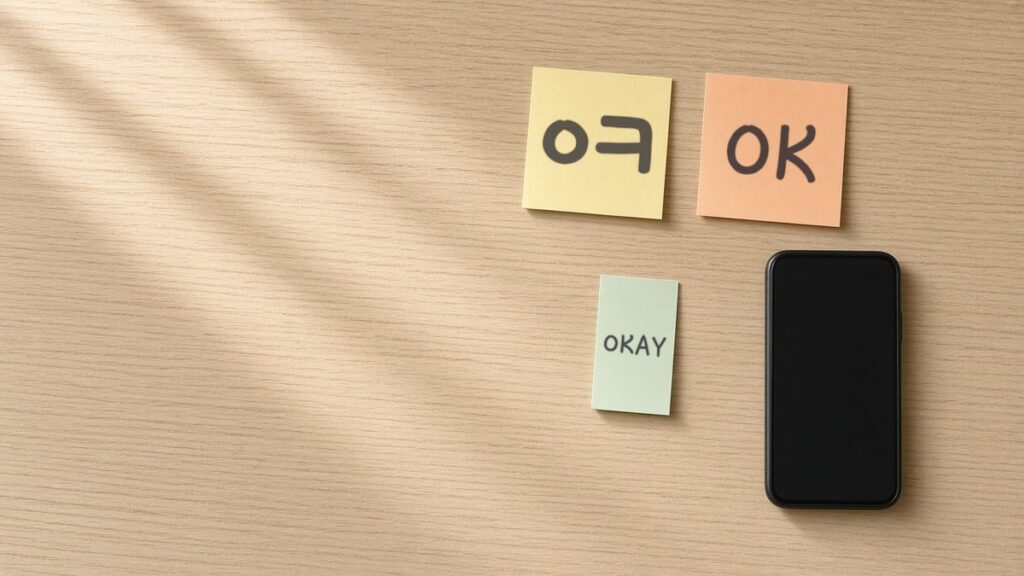
My memo is a complaint.
“A critique of 줄임말. They shorten everything.”
줄임말 means abbreviations, or shortened words. And the memo is right. In Korea, they really do shorten everything.
Then I moved to America and found out Americans do it too. So now I live in two languages, and both of them are in a hurry.
The Korean side
Korean abbreviations are a sport.
아이스 아메리카노 becomes 아아. Iced Americano, in two syllables. It’s the most efficient coffee order on Earth.
There’s even a word for this habit, and of course it’s an abbreviation. 별다줄. Short for 별걸 다 줄인다. “They shorten even the weirdest things.”
So the word for “abbreviating too much” was itself abbreviated. Somebody saw the problem and made it worse, on purpose. I respect it.
Then there’s texting. ㅇㅋ for okay. ㄱㅅ for thanks. Those are just the first consonants. The vowels didn’t make the cut.
The American side
English does the same thing. LOL. BRB. IDK. TBH. FWIW.
At work there’s another layer. EOD. OOO. ASAP. Emails can look like a bowl of alphabet soup.
ASAP is the one that got me. When I first came to the US, I didn’t know what it meant. Which is a little funny, because the whole point of ASAP is that there’s no time to stop and ask.
Do abbreviations sound rude?
Here’s where it gets interesting. In 2024, a study looked at exactly this.
Researchers David Fang and Yiran (Eileen) Zhang at Stanford and Sam Maglio at the University of Toronto ran eight experiments with more than 5,300 participants. They published the results in the Journal of Experimental Psychology: General. The paper’s title gives away the ending: “Shortcuts to Insincerity: Texting Abbreviations Seem Insincere and Not Worth Answering.”
Their main finding, from the American Psychological Association’s release: people who used abbreviations in texts were seen as less sincere. They also got shorter and fewer replies.
The release even had an abbreviated subhead: “FWIW, spell it out. K?” Someone in that press office was having a good day.
Fang said: “We thought texters might like abbreviations because it would convey an informal sense of closeness, so we were surprised that abbreviations elicited negative perceptions about people who use them.”
Here’s the funny part. In a preliminary survey by the same researchers, 99 percent of respondents said they used texting abbreviations themselves.
So we all do it. And we all think a little less of the other person when they do it. That’s a very human combination.
Why we shorten anyway
The study doesn’t say abbreviations are always bad. Fang mentioned a fair exception: “In some cases, it makes sense to invest less effort and accept being perceived as less sincere, like quickly texting with a delivery driver.”
That makes sense to me. Nobody needs a heartfelt paragraph about the front porch.
I think we shorten because we’re busy. And because everyone else shortens, so a long message starts to feel strange. Like wearing a suit to a barbecue.
What gets lost
My memo was a critique, so here’s the critique.
When everything gets shortened, some words lose their weight. “고맙습니다” is a full thank you. ㄱㅅ is a receipt.
“Thank you so much” sounds like a person. “ty” sounds like a vending machine that’s in a good mood.
And when you live in a second language, abbreviations are a wall. Full words you can look up. Some abbreviations you just have to already know.
What I’m trying
I’m not going to stop abbreviating. I’d lose.
Here’s what I actually do. With people I’m close to, I shorten. With everyone else, I write things out in full. Short is for friends. Full sentences are for everyone I’m still being polite to.
The idea I like from the study is simple. Fang said the findings matter most when we want to seem sincere, “such as at the beginning of a relationship or when we need to make a good impression.”
A short list, spelled out
Where I’d spell things out, in either language:
- A thank you that means something.
- A first message to someone new.
- An apology.
- Anything to my parents.
Everything else can probably stay short.