
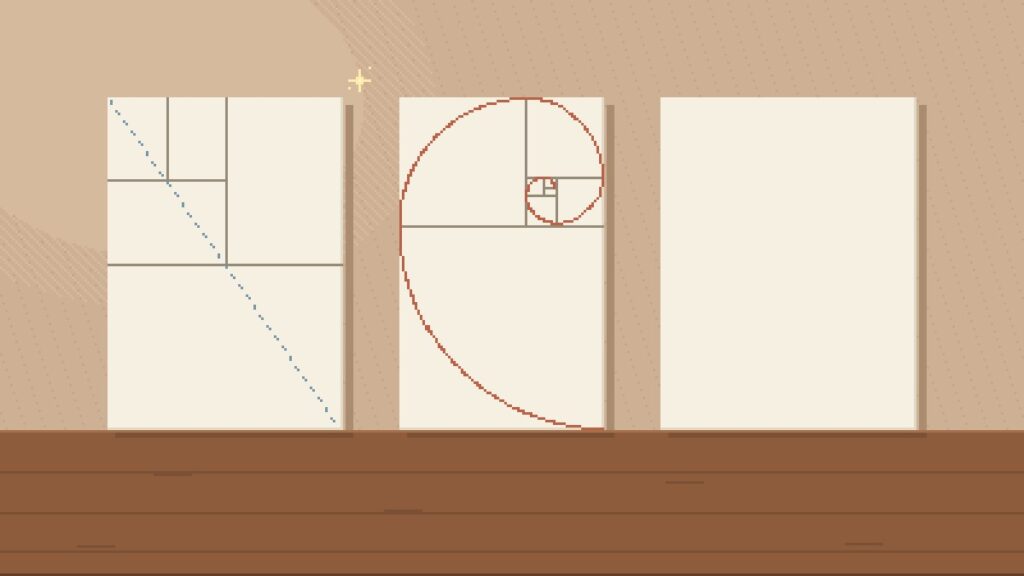
Here’s a memo I wrote at some point:
“A4 looks like a better ratio than the golden ratio.”
I stand by it. I’d like to apologize to the golden ratio’s fans in advance. I know you have posters.
Meet the two contenders
The golden ratio is about 1.618 to 1. It has a great publicist. It shows up in art books, logo tutorials and a lot of very confident internet diagrams with spirals on them.
A4 is a sheet of printer paper. It’s 210 by 297 millimeters. Its publicist is the office supply aisle.
The A4 ratio is 1 to the square root of 2. That’s about 1.414 to 1.
So A4 is a little less tall and skinny than a golden rectangle. On paper (sorry) that’s a small difference. But the two shapes come with very different tricks.
Why is A4 paper that size? The folding trick
Fold an A4 sheet in half and you get A5. Same shape. Fold that in half and you get A6. Still the same shape. It keeps going.
Go the other way and two A4 sheets side by side make A3. Same shape again.
Markus Kuhn at the University of Cambridge has a long, wonderful page about this. The whole system starts from A0, which has an area of exactly one square meter. Every size after that is the one before it, cut in half.
Only the square root of 2 can do this. Any other rectangle changes shape when you cut it in half. Try it with a golden rectangle and the halves come out wrong.
The golden ratio has its own trick, to be fair. Cut a square off one end and what’s left is another golden rectangle. Kuhn’s take on that: it’s “a property that seems not particularly useful for office applications.”
That’s about as polite as a burn gets.
How A4 and Letter got their sizes
Neither size fell out of the sky. Here’s the short version.
A4: a math idea that took 136 years to catch on
- 1786. On October 25, the Göttingen physics professor Georg Christoph Lichtenberg wrote a letter to his colleague Johann Beckmann. He’d given an algebra student a puzzle: find a sheet that keeps the same shape every time you fold it. The answer was a 1 to √2 rectangle. Then he grabbed some ordinary writing paper to cut it to that shape and found it already was. He wrote that the shape “has something pleasant and distinguished” compared with the usual one. It’s the oldest surviving written record of the idea that we know of, though he probably wasn’t the first to think of it. A version of the puzzle reportedly turned up in a math exam around 1755.
- 1798. On November 3, France passed a law on taxing paper, the “Loi sur le timbre.” Its official sheet sizes were already √2 rectangles. The biggest one, the “grand registre,” is today’s A2 almost to the millimeter, and the others match A3 and B sizes. Then everyone pretty much forgot about them.
- 1922. On August 18, Germany’s standards committee (today’s DIN) published DIN 476, based on the engineer Walter Porstmann’s system. It started from A0, one square meter, and halved it again and again. Halve it four times and you get A4: 210 by 297 mm.
- 1975. It became the international standard ISO 216, and the official United Nations document format that same year.
Letter: a compromise nobody designed
- The popular story: 8.5 by 11 goes back to hand papermaking. Molds were sized to what a papermaker could handle with outstretched arms, and a big handmade sheet cut into quarters gave you 8.5 by 11. The American Forest & Paper Association tells it this way. Kuhn calls it “one hypothesis.” It’s a good story, but nobody has proven it.
- 1921, the first try: Herbert Hoover, then Secretary of Commerce, made 8 by 10.5 inches the letterhead size for his department. Later that year, a government printing committee made it the standard for all federal letterhead.
- 1921, the second try: Separately, that August, an industry Committee on the Simplification of Paper Sizes worked with the Bureau of Standards, part of Hoover’s push to cut waste in industry. It picked 17 by 22 inches as a basic sheet. Cut that in half and you get 8.5 by 11. A 1972 account, quoted by Kuhn, found no sign “that any special analysis was made to prove that this provided an optimum size for a commercial letterhead.” It was about keeping stock simple and cutting with as little waste as possible.
- So for decades, the US had two letter sizes: 8 by 10.5 for the government, 8.5 by 11 for everyone else.
- 1980. Congress’s Joint Committee on Printing ordered federal offices to switch to 8.5 by 11 by January 1, 1980. Since then, the government and everyone else have used the same Letter size.
Today, in Kuhn’s words, A4 is “the paper format used by about 95% of the people on this planet.” The US, Canada and parts of Mexico are the main holdouts.
Then there’s me
I live in Seattle. Over a decade in the US now.
And the US mostly uses Letter. 8.5 by 11 inches. That’s about 216 by 279 millimeters, a ratio of roughly 1.29.
Fold Letter in half and you get a different shape, about 1.55. Fold that in half and it changes back. It’s like a rectangle that can’t decide who it wants to be.
I didn’t know any of this until I moved. In Korea I used A4. I brought my A4 documents with me to the US, and then I noticed the paper here was a different size. That threw me off. (Letter is a little wider and shorter than A4.)
That’s when I found out Letter and A4 aren’t the same thing.
So now I live with the other 5%, in Letter country.
What about “the golden ratio is the most beautiful”?
People have tested this. A lot.
Psychologists have been running golden-ratio preference studies since Gustav Fechner in the 1860s. Christopher Green reviewed that research in 1995. His conclusion was careful: there do seem to be “real psychological effects” tied to the golden section, but they’re “relatively sensitive to careless methodological practices.”
Translation: there’s something there. It’s just a lot smaller and shakier than the posters suggest.
So I’m allowed my opinion. Science hasn’t overruled me yet.
So, A4
Here’s what A4 has going for it.
Its shape isn’t there for decoration. It’s there because it works. Cut it in half and you get the same shape. Double it and you get the same shape again. That holds from a one-square-meter A0 all the way down to A10. Lichtenberg noticed it in 1786 and even called it “pleasant and distinguished.” The golden rectangle’s party trick is cutting off a square.
The golden ratio is beautiful. I’m not saying it isn’t.
But my memo stands: A4 looks like a better ratio.
Sources
- Markus Kuhn, “International standard paper sizes,” University of Cambridge Computer Laboratory
- Markus Kuhn, “Lichtenberg’s letter to Johann Beckmann” (original text and translation)
- Loi sur le timbre du 13 brumaire an VII (3 November 1798), Legilux (Luxembourg government legal portal)
- DIN, “Herzlichen Glückwunsch, A4!” (100 years of DIN 476, published 18 August 1922)
- ISO, ISO 216:1975, edition 1, published 1975-05
- American Forest & Paper Association, “Why is the standard paper size in the U.S. 8 1/2″ x 11″?” (archived)
- U.S. Bureau of Standards, “Report of the Committee on the Simplification of Paper Sizes,” August 30, 1921 (HathiTrust)
- TIME, “Americana: Paper Chase”
- Christopher D. Green, “All that glitters: a review of psychological research on the aesthetics of the golden section,” Perception 24 (1995): 937-968