
These days I work with AI almost every hour of the day. It drafts, it checks, it reminds, it finds things I’d never find on my own. And somewhere in the last year I noticed a quiet, slightly scary feeling: I don’t think I could do anything without it anymore.
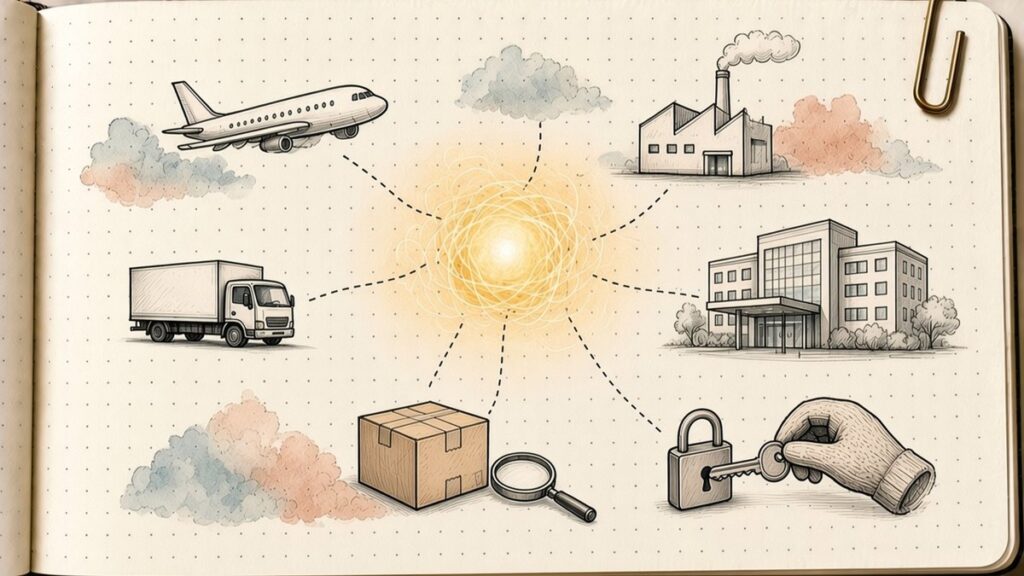
That got me thinking. If one person can get this dependent on AI, what does that look like for a whole company, with thousands of people, millions of records, and decisions every minute? Somebody has to be the AI layer that sits on top of all of it. More and more, I think that “somebody” might be Palantir.
So this week’s study topic is Palantir. I started with the company’s own explanation of itself.
What Palantir says about itself
On Aug 21, 2025, Palantir published “About Palantir: Answers to Frequently Asked Questions.” Keep in mind that the company wrote this about itself, so it’s Palantir’s framing, not a neutral review. Here’s my short version:
- It’s a software company. It sells data and AI platforms to governments, companies, and nonprofits in more than 50 industries: banks, carmakers, aircraft makers, food producers, the US Defense Department, health agencies, and allied militaries. It claims it can cut setup time “from months to days.”
- It’s built around something called an “ontology.” (More on that below, because it’s the key idea.)
- It’s not a data broker. Customers own and control their data. Palantir calls itself a “data processor, not a data controller.” It says it doesn’t sell data, doesn’t share it between customers, and doesn’t train AI models on customer data.
- Privacy is built in. Customers decide who sees what, how long data is kept, and every change is logged.
- Defense is a core mission. Palantir is openly “proud” to support the US military and its allies, including Ukraine. It argues a strong military is “itself, a moral good,” and that humans, not software, make the big decisions.
- It says it’s not a surveillance company and doesn’t do predictive policing. It works only with Western democracies and their allies, not with China’s Communist Party or Russia.
- It addresses its ICE contract directly. The work began in 2011 for the investigations division and expanded in 2025 to immigration-enforcement tools.
One update since then: the FAQ says the company is based in Denver, but Palantir moved its headquarters to the Miami area in February 2026.
Ontology, explained like you’re ten
“Ontology” sounds like a philosophy word. Palantir uses it to mean something simple. Here’s how I finally understood it.
Step 1: Your messy room. Imagine your toys are everywhere. LEGO in the closet, cars under the bed, game cards in three different backpacks. You own everything, but when your friend asks “how many red cars do you have?” you have no idea.
Step 2: Name the things. You decide your room has a few kinds of things: cars, LEGO sets, cards. Each car gets a little tag: color, size, which box it lives in.
Step 3: Draw the connections. Now you draw lines. This car belongs to this LEGO set. This card goes with this game. My friend borrowed this car on Tuesday. Your room is no longer a pile. It’s a map of things and how they’re connected.
Step 4: Add the actions. On the map you also write what you can do: “lend a car,” “put back,” “trade a card.” When you lend a car, the map updates by itself, so everyone always sees the real situation.
Step 5: Let a helper read the map. Now a robot helper (that’s the AI) can answer “where’s my red car?” or even suggest “you have two of the same card, want to trade one?” The robot is smart because the map is clean.
That map is the ontology. Data turns into things (objects), connections (links), and things you can do (actions), all in one place.
A real-business version: Think of an airplane maker. Its parts data is in one system, its suppliers in another, its factory schedule in a third, and airline repair records in a fourth. An ontology turns all of that into one map: this part → made by this supplier → goes into this plane → which is flying for this airline → which needs a repair next month. If a supplier is late, everyone sees which planes are affected, and they can reschedule right there. Palantir’s own example is Airbus’s Skywise platform, built on its Foundry software, which connects airlines and suppliers this way.
This is why Palantir says its AI is useful. The AI (its product is called AIP) isn’t guessing from a pile. It’s working on the map.
What impressed me most
The line that stuck with me is the simplest one: the customer’s data stays the customer’s. Palantir says it doesn’t use customer data for itself, doesn’t resell it, and doesn’t train AI on it.
Right now, that feels like the whole game. Every company wants AI, and every company is scared of handing its secrets to someone else’s model. If Palantir can really be the AI layer without owning your data, that’s a strong position.
Is it a surveillance company? My honest take
Palantir says no. Honestly, strictly speaking, I think it is. In defense and in business alike, you can only find solutions when you understand everything thoroughly and keep a close eye on it. That’s what this software does: it sees everything connected, all at once. To me that’s the point of the product, not a side effect. What matters is who’s watching, and under what rules.
And there are real reasons people worry:
- ICE. The ACLU says Palantir’s ImmigrationOS work helps build centralized files on people in the immigration system. Palantir says the customer controls the data and the use is lawful.
- German police. In 2023 Germany’s top court ruled that the laws letting two states run automated police data analysis were unconstitutional. One of those systems was built on Palantir’s Gotham.
- UK health service. British MPs have called for the £330 million NHS data contract to be scrapped, and the government will reconsider it in spring 2027.
I think both things are true. The software is powerful because it sees everything, and that’s exactly why the rules around it matter.
Palantir vs. Tesla: different bets
In my last post I wrote about why I’m not taking profits on Tesla. People lump the two together as “AI stocks,” but they’re very different. Palantir is pure software. It lives inside data centers and company systems. Tesla is adding AI to the physical world: cars that drive themselves, robots that walk, batteries that run homes. One bets on AI thinking. The other bets on AI moving.
Valuation: expensive, or still cheap for tech?
My gut says Palantir’s valuation is still on the low side for a tech company like this. Here’s how it compares (approximate, as of the Nov 2, 2026 close, after Palantir’s Q3 report):
| Palantir | Tesla | |
|---|---|---|
| Trailing P/E | ~126 | ~444 |
| Forward P/E | ~72–80 | ~190–200 |
| Price/sales | ~59 | ~15 |
On earnings, Palantir actually looks cheaper than Tesla. On sales, it’s one of the most expensive big companies out there. Which number you trust says a lot about which story you believe. Its growth is the reason people pay up: in Q2 2026, revenue grew 93% year over year to $1.935 billion, and US commercial revenue grew 149%.
Q3 2026 update (reported Nov 2): Revenue grew 96% year over year to $2.313 billion, the first quarter above $2 billion. US commercial revenue grew 148% to $984 million and, for the first time, passed US government revenue ($953 million, up 96%). Revenue outside the US grew 26% to $376 million. GAAP net income was $1.128 billion, a 49% margin, and GAAP earnings per share were $0.44. Palantir raised its full-year 2026 revenue guidance to $8.530–8.534 billion and its US commercial guidance to more than $3.559 billion, at least 143% growth, and it expects $2.649–2.653 billion in revenue for Q4.
What would change my mind
- US commercial growth slowing sharply after this year’s huge jump
- International business staying weak (it grew only 26% in Q2)
- Losing major government contracts, like the UK NHS deal at its 2027 review
- Growth no longer keeping up with that price-to-sales number
Where I stand
I don’t own Palantir yet. I’m watching it. I want to understand it better, and I’d rather study it through a few more quarters than jump in on a hunch.
This isn’t investment advice — just my notes.
Sources
- Palantir: About Palantir, Answers to Frequently Asked Questions (Aug 21, 2025)
- Palantir IR: Notice of principal executive office address change (2026)
- The Guardian: Palantir moves headquarters to Miami (Feb 17, 2026)
- Palantir Q2 2026 results press release (SEC)
- ACLU: All the ways Palantir is assisting Trump's abusive removal campaign
- German Federal Constitutional Court press release (Feb 16, 2023)
- The Guardian: MPs demand Palantir NHS contract be scrapped (Apr 16, 2026)
- Palantir Q3 2026 results press release (SEC, Nov 2, 2026)
- Palantir Q3 2026 Form 10-Q (SEC)
- SEC XBRL financial data: Palantir (trailing EPS and revenue for P/E and P/S)
- SEC XBRL financial data: Tesla (trailing EPS and revenue for P/E and P/S)
- Finviz: PLTR (Nov 2, 2026 close and forward P/E)
- StockAnalysis: PLTR statistics (forward P/E)
- Finviz: TSLA (Nov 2, 2026 close and forward P/E)
- StockAnalysis: TSLA statistics (forward P/E)