
Most battery news is about chemistry. This one is about the factory. Tesla says it now makes both electrodes of its 4680 cell with a “dry” process, something it first promised at Battery Day in 2020. I wanted one clean page on what Tesla actually confirmed, what the Maxwell deal really cost, what the cost claims really say, and where everyone else is.
Full disclosure: I own Tesla shares and SpaceX shares.
Dry vs. wet, in one minute
- Wet (the industry standard): mix the electrode powders with a liquid solvent into a slurry, coat it onto metal foil, then run it through long drying ovens and recover the solvent.
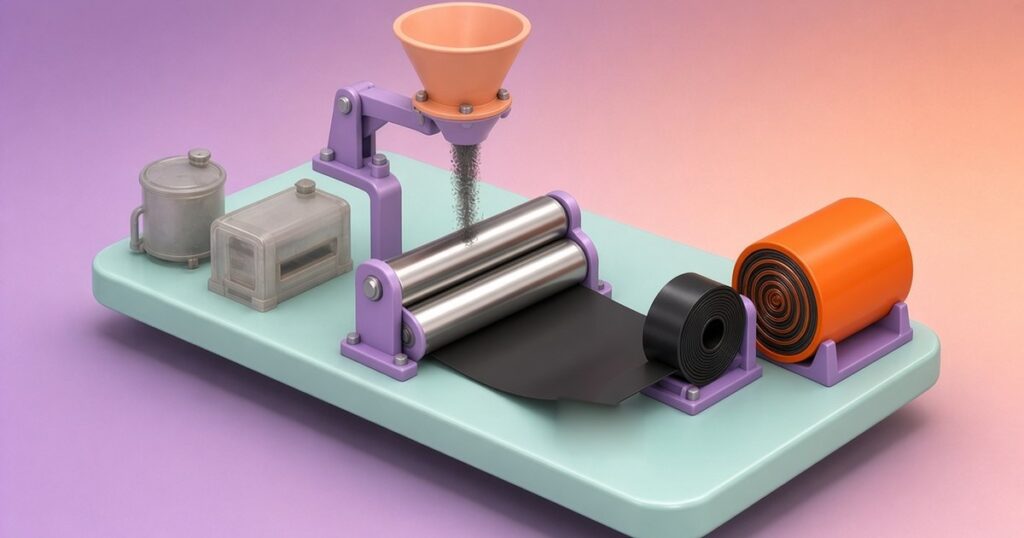
- Dry: mix the powders with a binder (Tesla’s patents describe PTFE, the Teflon family) and press them into a film with heavy rollers, then bond that film to the foil. No solvent, no drying ovens, no solvent recovery.
- Why it matters for investors: fewer steps and smaller lines should mean lower capex and lower cost per kWh. The catch has always been doing it at high speed with high yield, especially on the cathode side.
What Tesla actually confirmed
January 28, 2026 (Q4 and FY 2025 Update). Tesla’s shareholder letter says: “We now produce dry-electrode for 4680 cells with both anode and cathode made in Austin.” The same letter says Tesla had started building packs for certain Model Ys with its own 4680 cells, as an extra supply line given trade barriers and tariff risk.
- Bonne Eggleston, Tesla’s VP of 4680 batteries, posted on X the same day: “Both electrodes use our dry process.”
- Tesla’s capacity table lists 40 GWh of installed 4680 capacity in Texas, status “Production.” That’s installed capacity for 4680 cells overall, and Tesla’s own footnote says installed capacity is not the current production rate.
What Tesla did not say: how many of those cells are fully dry, or what the yield is. I’ve seen “>90% yield” floating around, but I couldn’t find it in any Tesla filing, letter or call, or in a major outlet. So I’m not using it.
Since then (Q3 2026 Update, Oct 21, 2026). Tesla lists 4680 at “>40 GWh” installed in Texas, still “Production,” and says it continues to increase 4680 output to support Cybercab, Tesla Semi and higher Model Y volumes. The letter doesn’t mention dry electrodes again.
The honest context. At the November 2025 shareholder meeting, a couple of months before that confirmation, Musk said the dry cathode “turned out to be a lot harder than we thought,” that it looked like it would succeed with “some cost advantage relative to wet cathode,” but that with hindsight he’d probably have chosen wet cathode. And back at Battery Day 2020 he called Maxwell’s process “proof of concept” that worked “but with not a high yield.”
The Maxwell deal: what it cost, and what Tesla kept
- Announced Feb 4, 2019: an all-stock deal valuing Maxwell at about $218 million ($4.75 a share, a 55% premium).
- Closed May 16, 2019: each Maxwell share became 0.0193 Tesla shares. In its Q2 2019 10-Q, Tesla put the fair value of the consideration at about $207 million (902,968 Tesla shares at $229.49). The “~$235 million” number some articles use doesn’t match either filing.
- July 2021: UCAP Power, started by former Maxwell leaders, bought the ultracapacitor business, Maxwell Technologies Korea, the Maxwell brand, and related patents and products. Tesla didn’t announce the sale itself. Musk confirmed it on X, and the dry battery electrode technology stayed with Tesla.
So Tesla paid roughly $200 million in stock, sold off the part it didn’t need, and kept the part it wanted: the dry electrode process.
The cost claims, quoted precisely
What Tesla itself said at Battery Day (Sept 22, 2020):
– Dry electrode should cut the footprint and energy use of electrode making by about 10x. That’s where “~90% smaller” comes from, but it’s about the electrode step, not the whole factory.
– All of Tesla’s cell factory changes together (dry electrode plus faster assembly and formation) were projected to cut battery cost per kWh by 18%. That’s part of Tesla’s 56% total target, and it’s not a cathode-only number.
What I could not trace to Tesla: the widely repeated line that dry cathode “cuts cathode cost by more than 18% and equipment investment by 41%.” Trade coverage attributes it to Tesla, but I found no Tesla document that says it. I’m treating it as unconfirmed.
For comparison, here’s what others say about their own processes:
– LG Energy Solution: expects dry electrodes to cut electrode manufacturing cost by 17% to 30%.
– PowerCo (Volkswagen): estimated about 30% less energy and 15% less floor space (2023).
– AM Batteries: claims 40% lower capex and a 5x smaller footprint for its own equipment (Oct 2025).
These are each company’s estimates for its own process, so they don’t compare one-to-one.
Who’s chasing
| Company | Stage (latest public info) | Where | Target date | Source |
|---|---|---|---|---|
| Tesla | Producing 4680 cells with dry anode and dry cathode; volume and yield not disclosed | Giga Texas, Austin | Already in production (Jan 2026) | Tesla Q4 2025 Update |
| LG Energy Solution | Pilot line at Ochang; said in Mar 2025 it had confirmed mass-production capability there | Ochang, South Korea | Commercial production “by 2028”; Apr 2026: dry-process LFP cathodes “from 2029” | LGES Battery Inside; Chosunbiz; Seoul Economic Daily |
| Samsung SDI | “DryEV” pilot line, pilot production since Sept 2024 | Cheonan, South Korea | Not disclosed | Samsung SDI Newsroom |
| SK On | Pilot line completed in 2024; “accelerating development toward commercialization” | South Korea | Not disclosed | SK Innovation (InterBattery 2026) |
| Panasonic | Reported pilot line for a dry process for 4680 | Wakayama, Japan | Not disclosed | Seoul Economic Daily (reported; no Panasonic statement found) |
| PowerCo (VW) + Koenig & Bauer | Proof of concept passed June 2025; moving to a PowerCo pilot line | Germany | 2023: production start estimated 2026/2027. 2025: scaling work to finish in 2026 | Volkswagen Group; Koenig & Bauer |
| CATL | Reported to be reviewing dry process for large cells | China | Not disclosed | Seoul Economic Daily (reported) |
| BYD | Reported to be considering it for solid-state and other products | China | Not disclosed | Seoul Economic Daily (reported) |
| LiCAP Technologies | Makes “Activated Dry Electrode” electrodes (started with ultracapacitors); co-developing dry cathodes with Nissan for solid-state cells | Sacramento, California | Supports Nissan’s targeted 2028 solid-state rollout | CALSTART; LiCAP |
| AM Batteries | Dry-coating equipment supplier; two engineering pilot lines ran at 20 m/min at its Oct 2025 demo | Billerica, Massachusetts | Not disclosed | AM Batteries press release |
A few notes on the table:
– LG Energy Solution’s target has moved. Its 2024–2025 materials say commercial production by 2028. In April 2026 an LGES executive told Seoul Economic Daily the goal is dry-process LFP from 2029. The same article calls Tesla’s progress “little,” which was written after Tesla’s January letter, so I’d read that as a competitor’s view.
– PowerCo’s date is fuzzy. The 2026/2027 production estimate came from 2023. The 2025 update only says scaling work will finish in 2026.
– LiCAP and AM Batteries are more than research labs. LiCAP already makes dry electrodes, and AM Batteries sells the machines.
So, is Tesla the only one at mass-production scale?
From public sources, Tesla is the only company that says it is producing EV cells in a production factory with both electrodes made dry. Everyone else on this list says pilot, development, or review. LiCAP makes dry electrodes, but mainly for ultracapacitors and partner programs, not EV cells at gigafactory scale.
But “mass-production scale” is more than Tesla has shown. Tesla hasn’t said how many fully dry cells it makes, what share of its 4680 output they are, or what the yield is. The 40 GWh figure covers 4680 capacity overall, not dry-cathode output. And Musk himself said the dry cathode was much harder than expected.
My take
What Tesla is pulling off here is truly remarkable, and I think a lot of investors are missing it.
What I’ll watch
- Will Tesla ever disclose how many fully dry 4680 cells it makes, or a yield number?
- Does the 4680 ramp for Cybercab and Semi show up as lower battery cost in Tesla’s results?
- Does LG Energy Solution hit 2028, or does 2029 become the real date?
- When does PowerCo’s pilot line become a series-production date?
- Do any of the pilot lines (Samsung SDI, SK On, Panasonic) announce a production date?
I’ll update this after the next round of reports.
This isn’t investment advice — just my notes.
Sources
- Tesla, Q4 and FY 2025 Update (Jan 28, 2026), via SEC 8-K Exhibit 99.1; deck
- Tesla, Q3 2026 Update (Oct 21, 2026)
- Electrek, "Tesla puts 4680 battery cells back in Model Y; Here's why," Jan 28, 2026
- Teslarati, "Tesla confirms that it finally solved its 4680 battery's dry cathode process" (Bonne Eggleston's X post), Jan 30, 2026
- Tesla 2025 Annual Shareholder Meeting, transcript of Musk's remarks on dry cathode (Nov 2025)
- Tesla, Battery Day 2020 presentation deck; Ars Technica, "How Tesla plans to make batteries cheap enough for a $25,000 car," Sept 23, 2020
- P3 Group, "Tesla Battery Day 2020 – Technology Announcement Analysis" (cost-step breakdown)
- CNBC, "Tesla to buy energy tech company Maxwell Technologies for about $218 million," Feb 4, 2019
- Tesla press release (SEC), "Tesla Completes Acquisition of Maxwell Technologies," May 16, 2019; Maxwell 8-K
- Tesla, Form 10-Q for Q2 2019 (Maxwell purchase consideration note)
- UCAP Power, "UCAP Power, Inc. Acquires Assets From Maxwell Technologies," Business Wire, Jul 14, 2021; pv magazine, Jul 30, 2021
- LG Energy Solution, Battery Inside, "Innovative Dry Electrode Process Enhancing Manufacturing Efficiency by Eliminating the Drying Step"
- Chosunbiz, "LG Energy Solution launches dry electrode process for batteries set to start in 2028," Mar 25, 2025
- Seoul Economic Daily, "LG Energy Solution Targets China's Battery Dominance with Dry Electrode Process," Apr 28, 2026
- Samsung SDI Newsroom, "Why Is Dry Electrode Process in the Spotlight?," Nov 19, 2024
- SK Innovation, "INTERBATTERY 2026 Preview: Next-Generation Battery Innovation at the SK On Booth," Mar 10, 2026
- Volkswagen Group, "PowerCo Develops 'Gamechanger' Technology for Cell Production," Jun 16, 2023
- Koenig & Bauer, "Koenig & Bauer and PowerCo SE: Successful Proof of Concept," Jun 3, 2025
- CALSTART, "LiCAP Is Redesigning Battery Manufacturing from the Ground Up," Feb 24, 2026; LiCAP
- AM Batteries, "Tier-One OEMs and Cell Manufacturers Validate AMB's Powder to Electrode Technology at Live Production Demo," Oct 28, 2025