
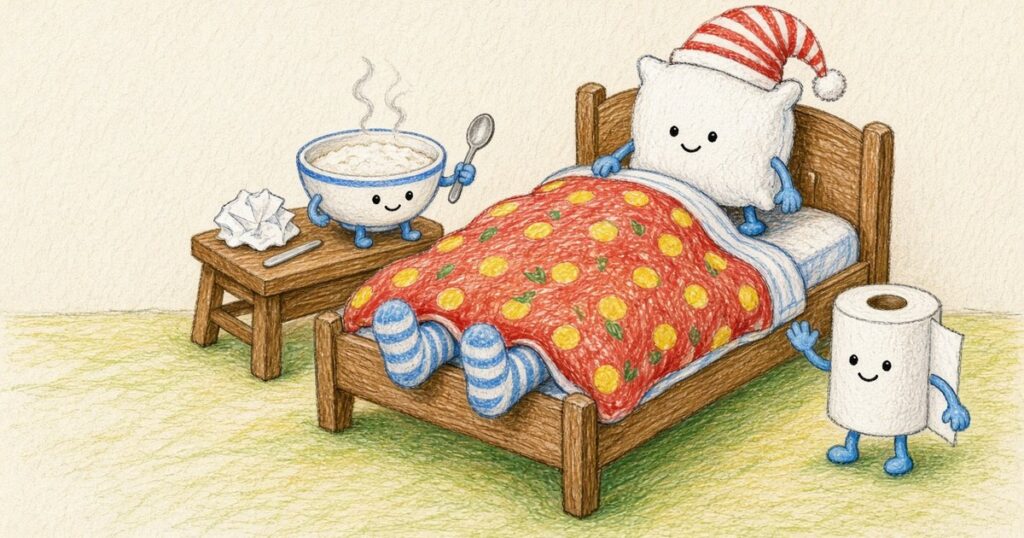
Someone close to me caught a cold.
It didn’t come out of nowhere. Work had been piling up. There were all-nighters. Sleep came at odd hours, whenever it could fit in. Meals got skipped, or eaten standing up, or forgotten. No workouts. No sauna. Nothing to get the blood moving or work up a good sweat.
They were completely absorbed in work. And that’s exactly the moment the cold virus showed up, with no real rest in the tank to meet it.
So of course it didn’t go away fast. It’s been several days now, and they’re still fighting it.
Watching this, I kept thinking: this is what a lot of modern life looks like.
The three basics
Here’s the line I keep coming back to:
Sleep well. Eat well. Poop well.
It sounds like something you’d say to a kid. It looks basic. It looks easy. But for a lot of people today, I think it’s the hardest homework there is.
I wanted to check whether the science agrees with what I saw. Here’s what I found.
Sleep: the one that’s easiest to steal from
When work gets heavy, sleep is the first thing we borrow from. It feels free. It isn’t.
The CDC says adults 18 to 60 need 7 or more hours of sleep a night.
There’s also a study I find hard to forget. Researchers measured how 164 healthy adults actually slept for a week, using wrist trackers. Then they put a cold virus into everyone’s nose and watched who got sick. People who slept under 6 hours a night were about four times more likely to develop a cold than people who slept more than 7 (Prather et al., SLEEP, 2015).
One study, not the final word. But it lines up with what I watched happen.
Eat: not supplements, just food
Skipping meals for work feels like a small thing. One missed lunch won’t break anyone.
But weeks of it add up. The NIH Office of Dietary Supplements says the immune system needs enough vitamins and minerals to work properly, and that falling short on them can make infections more likely and recovery slower.
The same NIH page also says something people don’t like to hear. If you aren’t actually deficient, piling on extra supplements usually doesn’t prevent infections or help you get better faster. Its answer is the boring one: eat a variety of real food.
So “eat well” doesn’t mean a cabinet full of pills. It means actually eating. Regularly.
Move and sweat: what’s true, and what’s a little overstated
Exercise or a sauna would at least have gotten the blood flowing and worked up a sweat. But how much does that actually help?
Some of that holds up well. A large research review found that regular moderate exercise is linked to fewer illnesses like colds, and that it helps the immune system do its patrol work (Nieman & Wentz, Journal of Sport and Health Science, 2019). The same review notes that very hard, intense training can push the risk the other way. So moderate is the word.
The sauna has some evidence too, but it’s thin. One small study from 1990 followed 50 people for six months. The group that used a sauna once or twice a week caught fewer colds, though their colds didn’t end faster or feel milder. It was small and not randomized, and even the authors said more studies were needed.
Now the part I have to be honest about: “sweating out toxins.” It’s a nice feeling, but the science doesn’t really back it. Researchers at the University of Ottawa estimated that even a liter of sweat a day removes only a tiny fraction of a percent of the pollutants we take in from food each day. Your liver and kidneys do the real cleanup.
So a good sweat still has its place. Just think of it as part of moving and resting well, not as a filter.
Poop well: the unglamorous one
Nobody puts this on a vision board. But it’s a pretty honest report card on the other two.
The NIH’s digestive health institute says the basic ways to stay regular are enough fiber, plenty of water, and regular physical activity. Notice that list. It’s eating well and moving, again.
When sleep, food and movement fall apart, this one usually goes too.
Why the basics are so hard
None of this is a secret. Everyone knows sleep, food and movement matter.
But work doesn’t stop on its own. There’s always one more thing. The basics get pushed to “later,” and later becomes a cold you can’t shake for days.
That’s what I saw this week. Someone fully in the middle of modern life.
What to do when the cold is already here
Once it’s here, the CDC’s advice is plain: get plenty of rest and drink plenty of fluids. Antibiotics don’t work on cold viruses. And if things get worse, or don’t improve, check with a doctor.
As for me, I’m keeping the homework simple.
Sleep well. Eat well. Poop well.
It’s the easiest-looking assignment I know, and the hardest one to actually hand in.
This post is my own reflection, not medical advice. If you’re sick or worried about your health, talk to a doctor or other health care professional.
Sources
- CDC, “About Sleep”
- Prather AA, Janicki-Deverts D, Hall MH, Cohen S. “Behaviorally Assessed Sleep and Susceptibility to the Common Cold.” SLEEP 38(9), 2015
- NIH Office of Dietary Supplements, “Dietary Supplements for Immune Function and Infectious Diseases” (consumer fact sheet)
- Nieman DC, Wentz LM. “The compelling link between physical activity and the body’s defense system.” Journal of Sport and Health Science 8(3), 2019
- Ernst E, Pecho E, Wirz P, Saradeth T. “Regular sauna bathing and the incidence of common colds.” Annals of Medicine 22(4), 1990
- Imbeault P, Ravanelli N, Chevrier J. “Can POPs be substantially popped out through sweat?” Environment International 111, 2018
- NIDDK (NIH), “Treatment for Constipation”
- CDC, “Manage Common Cold”